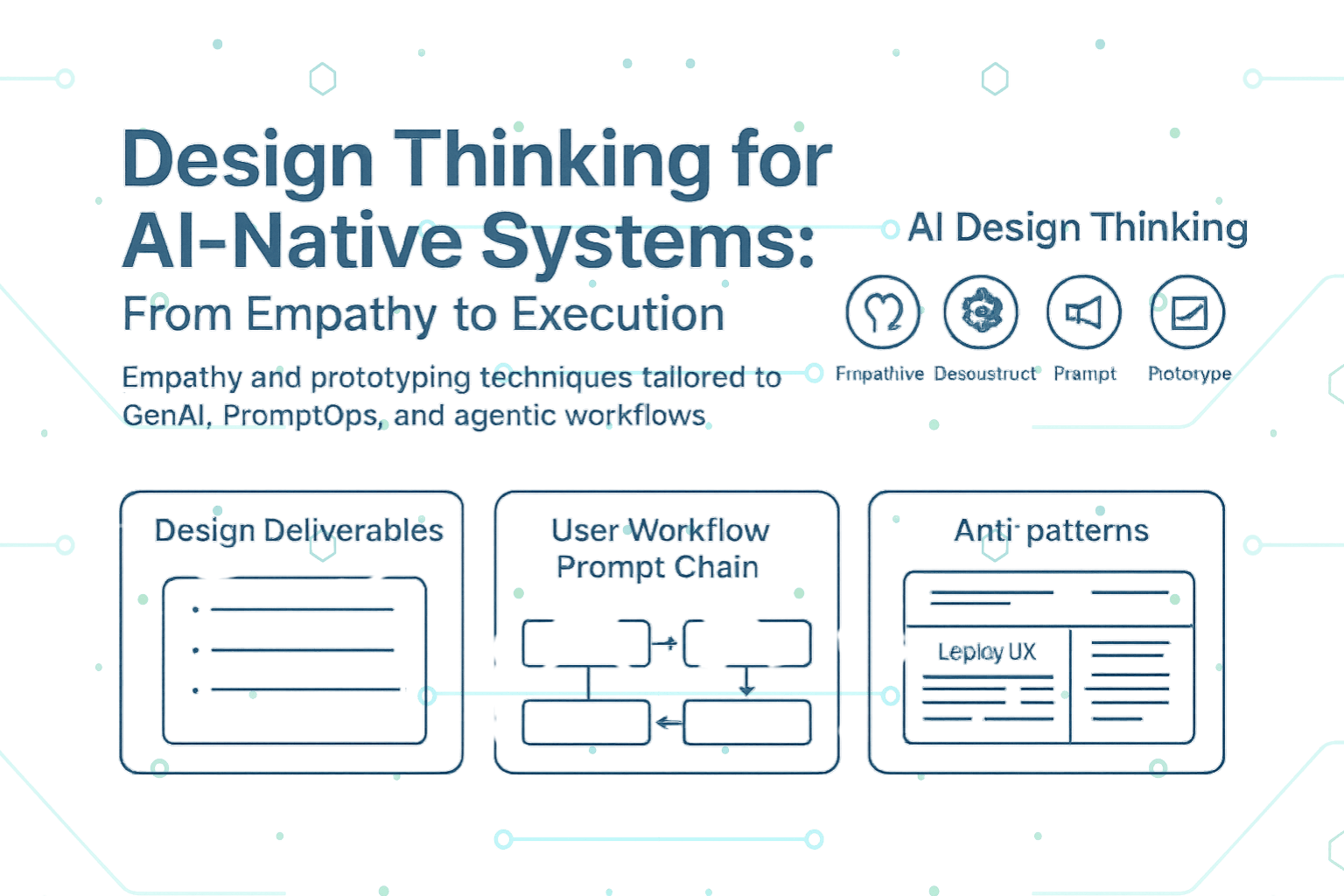
This is Post 2 of the 4-part AI Blueprint Series - your execution blueprint:
- 🔗 Design Thinking for AI-Native Systems →
- You are here →Design Thinking for AI-Native Systems
- 🔗 AI ProcessOps: The New Org Layer →
- 🔗 From Strategy to Stack →
Discovery Sets the Direction. Design Brings It to Life.
Most GenAI pilots fail not because of bad models - but because of poor design.
AI systems are not deterministic. They don’t follow scripts - they follow intent. And when you don’t design for intent, context, and prompt logic, you don’t get outcomes. You get drift.
That’s why at AIC, we apply a new form of Design Thinking - tailored for GenAI, ProcessOps, PromptOps, and agentic workflows.
🚫 Why Traditional Design Thinking Fails in AI Projects
| Legacy UX Mindset | AI-Native Reality |
|---|---|
| Linear click-based flows | Goal-based agentic flows |
| Deterministic outputs | Probabilistic + dynamic responses |
| Fixed UI/UX layout | Flexible prompt and output formats |
| UX bugs are visual | AI bugs are logical/contextual (hallucination, prompt drift) |
| Task = Screen or Form | Task = Completion via GenAI (summary, draft, suggest, respond) |
📌 Designing for AI = Designing for behavior + flexibility + fallback.
🎯 Introducing the AIC 4E Framework
AIC AI Design Thinking = Empathize → Extract → Engineer → Evaluate
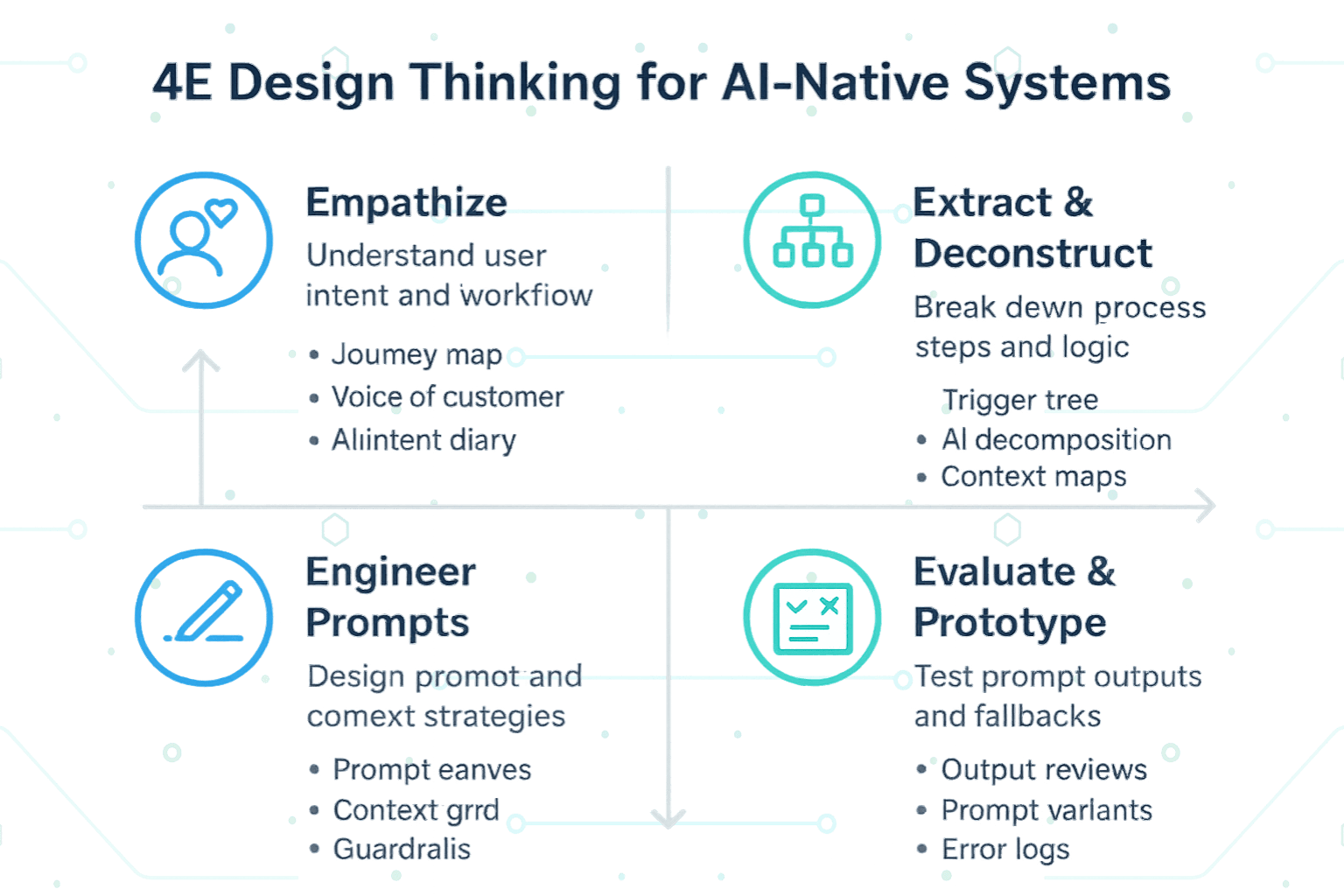
🔷 1. Empathize
Goal: Understand users, process frictions, intent clarity, and trust boundaries.
Tools:
- AI Intent Diary
- Actor-Prompt Journey Map
- Empathy Interviews with SMEs
Deliverable:
- Annotated User Journey with AI entry/exit points
🔷 2. Extract & Deconstruct
Goal: Break workflows into decomposed logic for agents and LLMs to act on.
Tools:
- Trigger Tree Diagrams
- AI Decomposition Table
- Context Source Mapping
Deliverable:
- Step-by-step Trigger Flow with tags: AI / HITL / Rules / API
🔷 3. Engineer Prompts
Goal: Create, contextualize, chain, and constrain prompts for reliability.
Tools:
- Prompt Canvas
- Context Injection Grid
- Guardrail Framework (Tone, Fallback, Length, Scope)
Deliverables:
- Prompt Variants
- Context Chain Logic
- Approval Constraints
🔷 4. Evaluate & Prototype
Goal: Validate quality, consistency, and safety across prompt iterations.
Tools:
- Prompt Variants Matrix
- Output Review Table
- Hallucination/Drift Logs
Deliverables:
- Prompt testing logs
- Rejection triggers + fallback paths
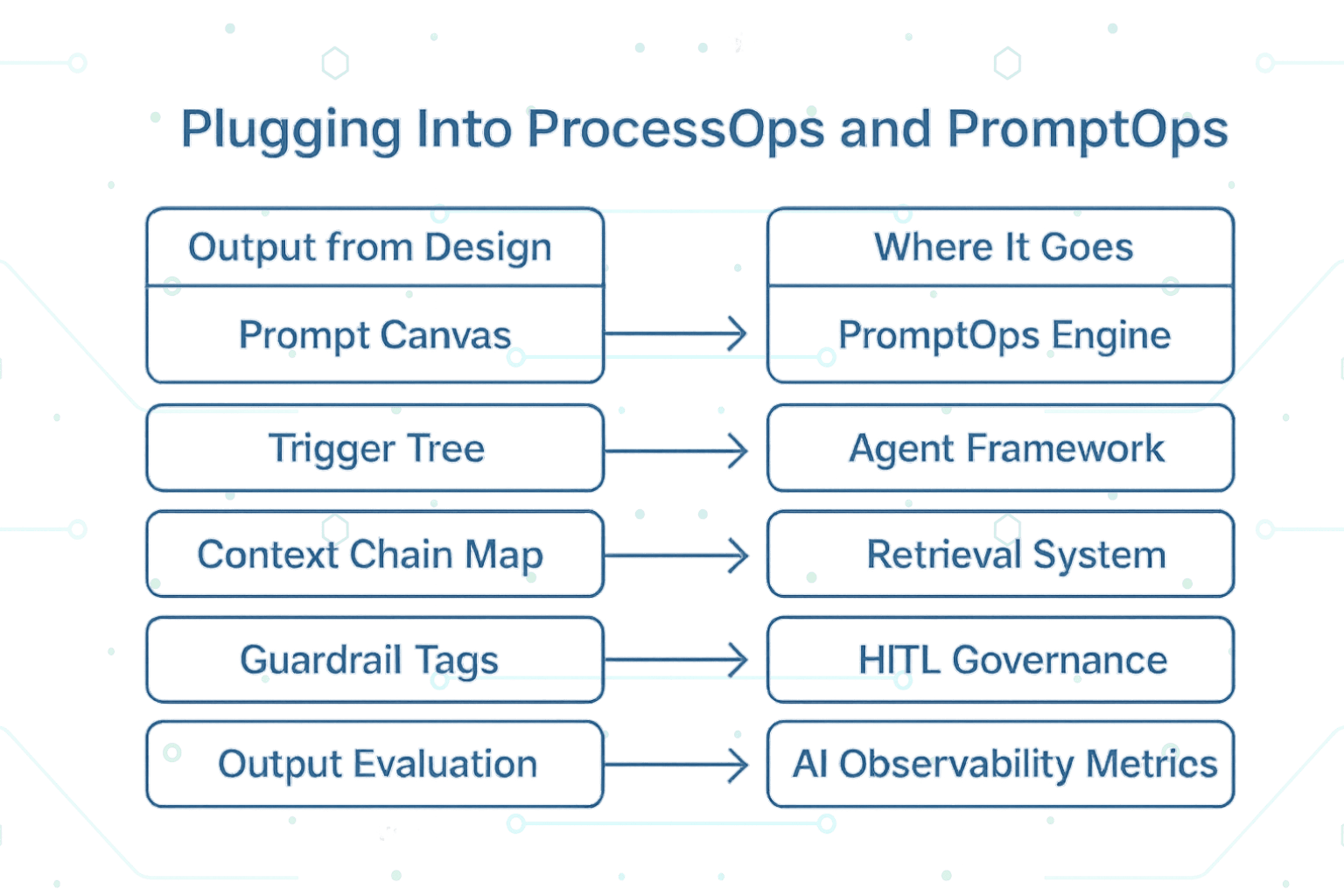
🧩 Plugging Into ProcessOps and PromptOps
The outputs of this phase fuel the ProcessOps layer:
| Output from Design | Where It Goes |
|---|---|
| Prompt Canvas | PromptOps Engine |
| Trigger Tree | Agent Framework |
| Context Chain Map | Retrieval System |
| Guardrail Tags | HITL Governance |
| Output Evaluation | AI Observability Metrics |
👥 Roles & Responsibilities in AI Design
| Role | What They Do |
|---|---|
| Process Designer | Identifies bottlenecks, trigger points, manual loops |
| Prompt Engineer | Crafts prompt sets, fallback variants, chaining |
| UX Designer | Builds AI-native UIs (preview, regenerate, co-pilot UX) |
| Business SME | Validates use case logic + output accuracy |
| Data Lead | Maps structured/unstructured inputs, vector needs |
📄 Design Phase Deliverables
| Deliverable | Purpose |
|---|---|
| 🎯 AI Journey Map | User process → AI opportunity → LLM role |
| 🧠 PromptOps Canvas | Prompts, fallback logic, context config |
| 🧩 Trigger Tree Diagram | Workflow logic flow for agent orchestration |
| 📈 Output Review Table | Evaluation matrix for success, tone, safety |
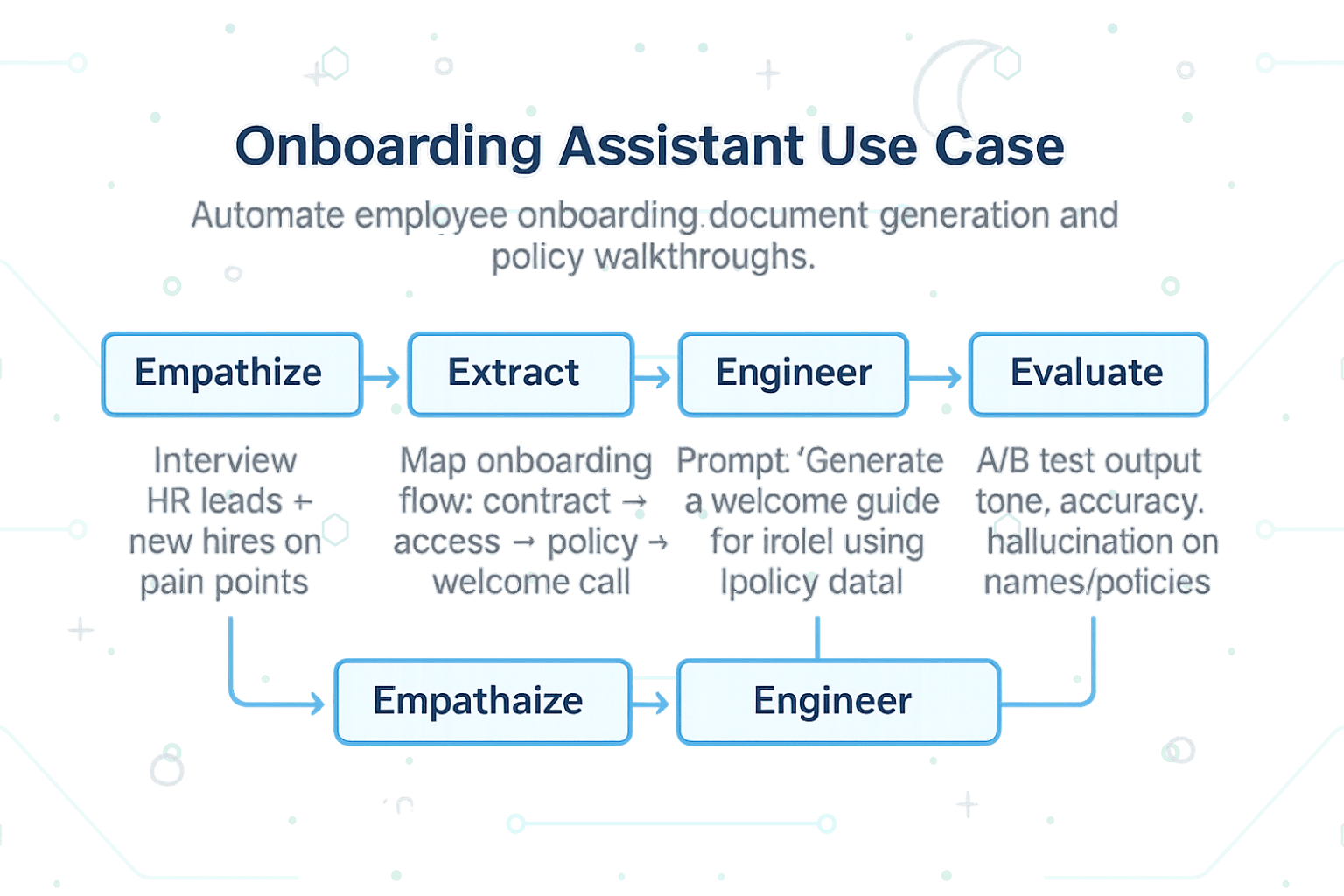
🧠 Example: Onboarding Assistant Use Case
Goal: Automate employee onboarding document generation and policy walkthroughs.
| Stage | Action |
|---|---|
| Empathize | Interview HR leads + new hires on pain points |
| Extract | Map onboarding flow: contract → access → policy → welcome call |
| Engineer | Prompt: “Generate a welcome guide for [role] using [policy data]” |
| Evaluate | A/B test output tone, accuracy, hallucination on names/policies |
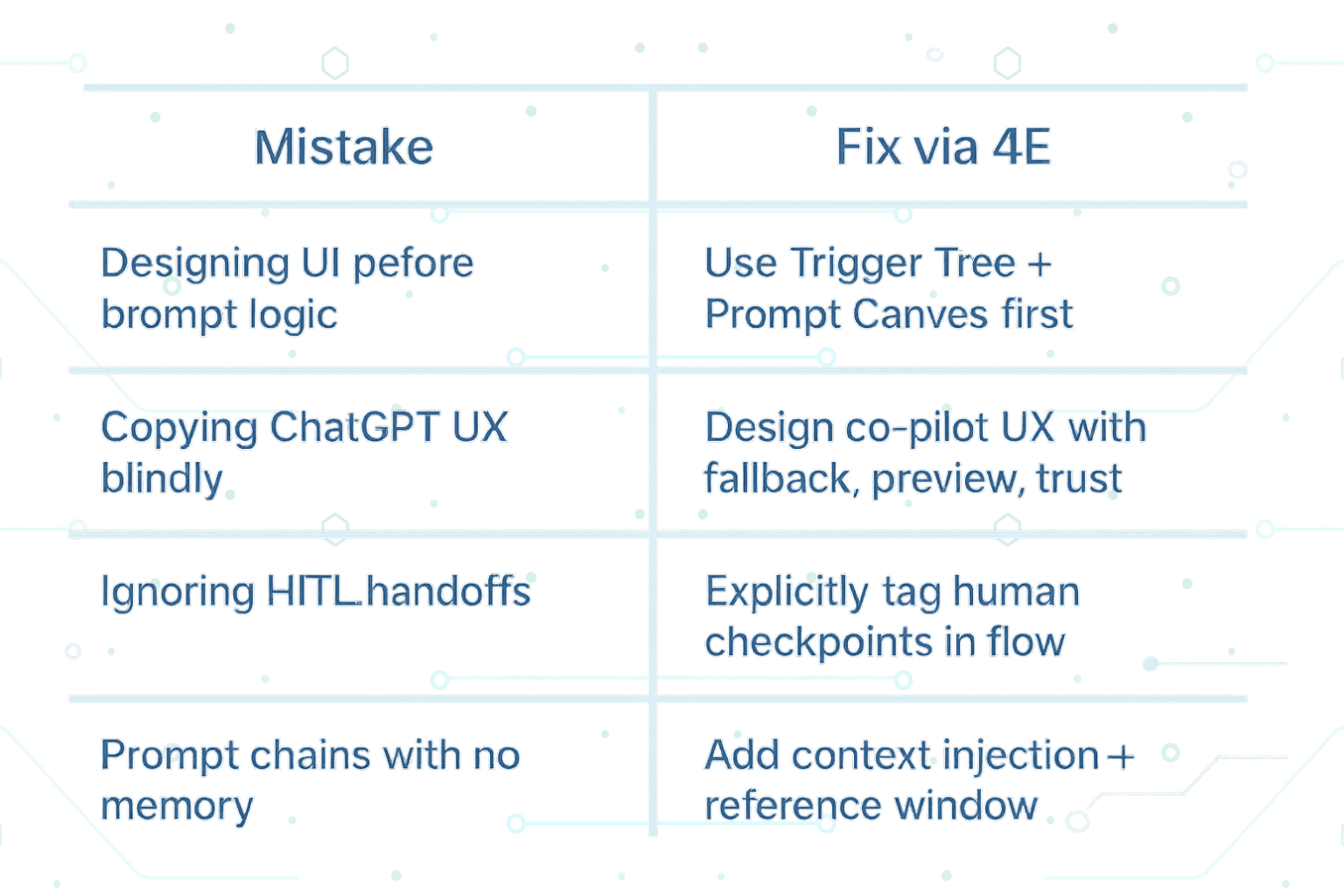
❌ Design Anti-Patterns to Avoid
| Mistake | Fix via 4E |
|---|---|
| Designing UI before prompt logic | Use Trigger Tree + Prompt Canvas first |
| Copying ChatGPT UX blindly | Design co-pilot UX with fallback, preview, trust |
| Ignoring HITL handoffs | Explicitly tag human checkpoints in flow |
| Prompt chains with no memory | Add context injection + reference window |
📈 From Design to Deployment: The Blueprint Bridge
This Design phase directly powers your AI ProcessOps Blueprint:
- Prompts → feed the PromptOps layer
- Triggers → define Agentic workflows
- Context + Guardrails → define LLM stack requirements
- Outputs → define monitoring & improvement loops
🧩 Now you're ready to build the Blueprint that runs your AI-native business.
🔚 Ready to Prototype with Purpose?
Move from prompt chaos to design clarity.
🔘 Download the AIC PromptOps Starter Kit →
🔘 Book a Co-Design Workshop with Our Team →
🔘 Explore the Full AI Blueprint Framework →
🧭 Where This Fits In Your AI Journey
This is Post 2 of 4 in the AI In Chief - AI Blueprint Series:
 Pritam
You are here → Design Thinking for AI-Native Systems
 Pritam
 Pritam
📌 Part of the AI Blueprint Series: From Discovery to Deployment
Get the next guide free - your next lesson lands every Sunday.
You're in ✓ - check your inbox to confirm.