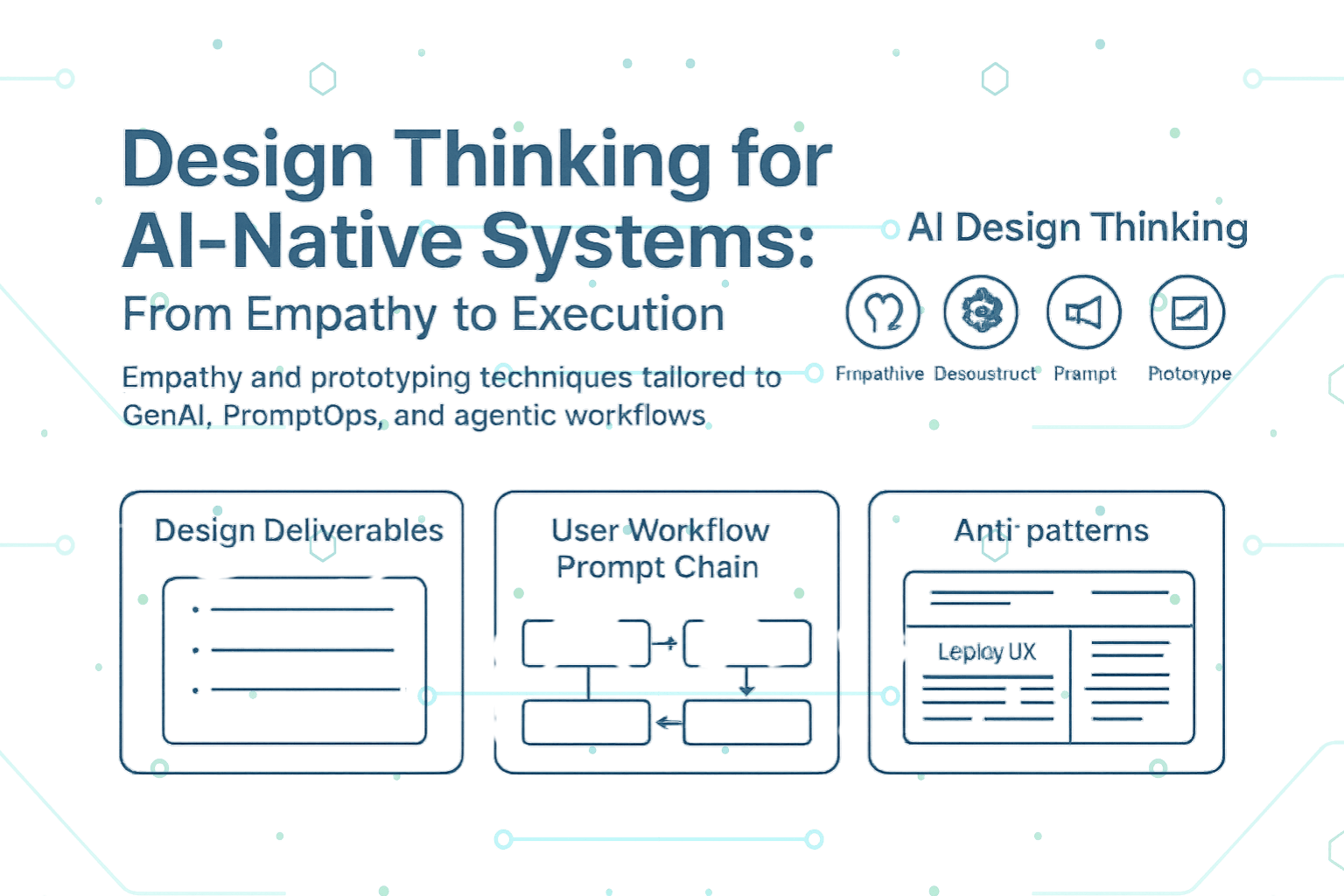
Design Thinking for AI-Native Systems: From Empathy to Execution
Empathy and prototyping techniques tailored to GenAI, PromptOps, and agentic workflows

This is Post 2 of the 4-part AI Blueprint Series - your execution blueprint:
- 🔗 Design Thinking for AI-Native Systems →
- You are here →Design Thinking for AI-Native Systems
- 🔗 AI ProcessOps: The New Org Layer →
- 🔗 From Strategy to Stack →
Discovery Sets the Direction. Design Brings It to Life.
Most GenAI pilots fail not because of bad models - but because of poor design.
AI systems are not deterministic. They don’t follow scripts - they follow intent. And when you don’t design for intent, context, and prompt logic, you don’t get outcomes. You get drift.
That’s why at AIC, we apply a new form of Design Thinking - tailored for GenAI, ProcessOps, PromptOps, and agentic workflows.
🚫 Why Traditional Design Thinking Fails in AI Projects
| Legacy UX Mindset | AI-Native Reality |
|---|---|
| Linear click-based flows | Goal-based agentic flows |
| Deterministic outputs | Probabilistic + dynamic responses |
| Fixed UI/UX layout | Flexible prompt and output formats |
| UX bugs are visual | AI bugs are logical/contextual (hallucination, prompt drift) |
| Task = Screen or Form | Task = Completion via GenAI (summary, draft, suggest, respond) |
📌 Designing for AI = Designing for behavior + flexibility + fallback.
🎯 Introducing the AIC 4E Framework
AIC AI Design Thinking = Empathize → Extract → Engineer → Evaluate
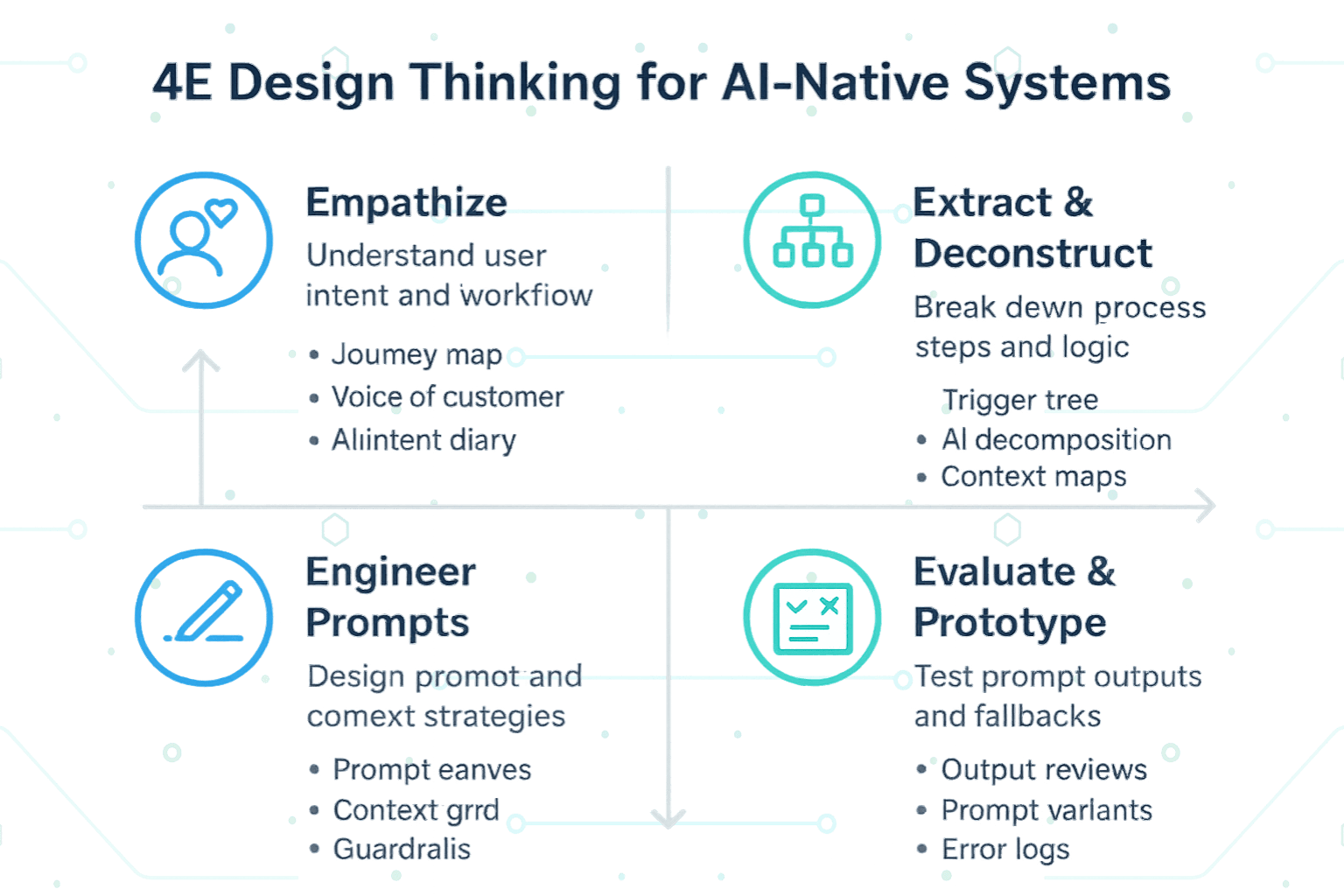
🔷 1. Empathize
Goal: Understand users, process frictions, intent clarity, and trust boundaries.
Tools:
- AI Intent Diary
- Actor-Prompt Journey Map
- Empathy Interviews with SMEs
Deliverable:
- Annotated User Journey with AI entry/exit points
🔷 2. Extract & Deconstruct
Goal: Break workflows into decomposed logic for agents and LLMs to act on.
Tools:
- Trigger Tree Diagrams
- AI Decomposition Table
- Context Source Mapping
Deliverable:
- Step-by-step Trigger Flow with tags: AI / HITL / Rules / API
🔷 3. Engineer Prompts
Goal: Create, contextualize, chain, and constrain prompts for reliability.
Tools:
- Prompt Canvas
- Context Injection Grid
- Guardrail Framework (Tone, Fallback, Length, Scope)
Deliverables:
- Prompt Variants
- Context Chain Logic
- Approval Constraints
🔷 4. Evaluate & Prototype
Goal: Validate quality, consistency, and safety across prompt iterations.
Tools:
- Prompt Variants Matrix
- Output Review Table
- Hallucination/Drift Logs
Deliverables:
- Prompt testing logs
- Rejection triggers + fallback paths
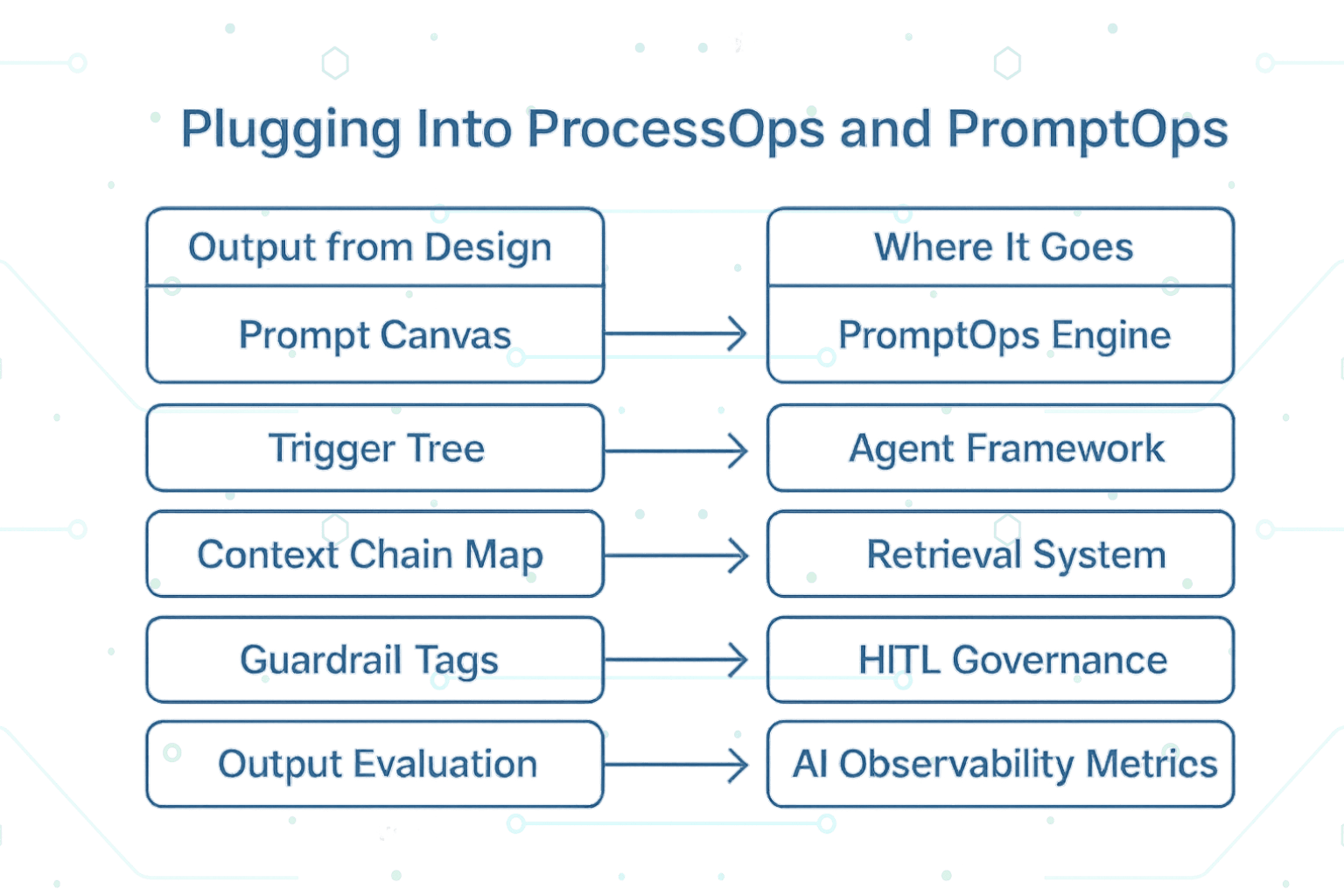
🧩 Plugging Into ProcessOps and PromptOps
The outputs of this phase fuel the ProcessOps layer:
| Output from Design | Where It Goes |
|---|---|
| Prompt Canvas | PromptOps Engine |
| Trigger Tree | Agent Framework |
| Context Chain Map | Retrieval System |
| Guardrail Tags | HITL Governance |
| Output Evaluation | AI Observability Metrics |
👥 Roles & Responsibilities in AI Design
| Role | What They Do |
|---|---|
| Process Designer | Identifies bottlenecks, trigger points, manual loops |
| Prompt Engineer | Crafts prompt sets, fallback variants, chaining |
| UX Designer | Builds AI-native UIs (preview, regenerate, co-pilot UX) |
| Business SME | Validates use case logic + output accuracy |
| Data Lead | Maps structured/unstructured inputs, vector needs |
📄 Design Phase Deliverables
| Deliverable | Purpose |
|---|---|
| 🎯 AI Journey Map | User process → AI opportunity → LLM role |
| 🧠 PromptOps Canvas | Prompts, fallback logic, context config |
| 🧩 Trigger Tree Diagram | Workflow logic flow for agent orchestration |
| 📈 Output Review Table | Evaluation matrix for success, tone, safety |
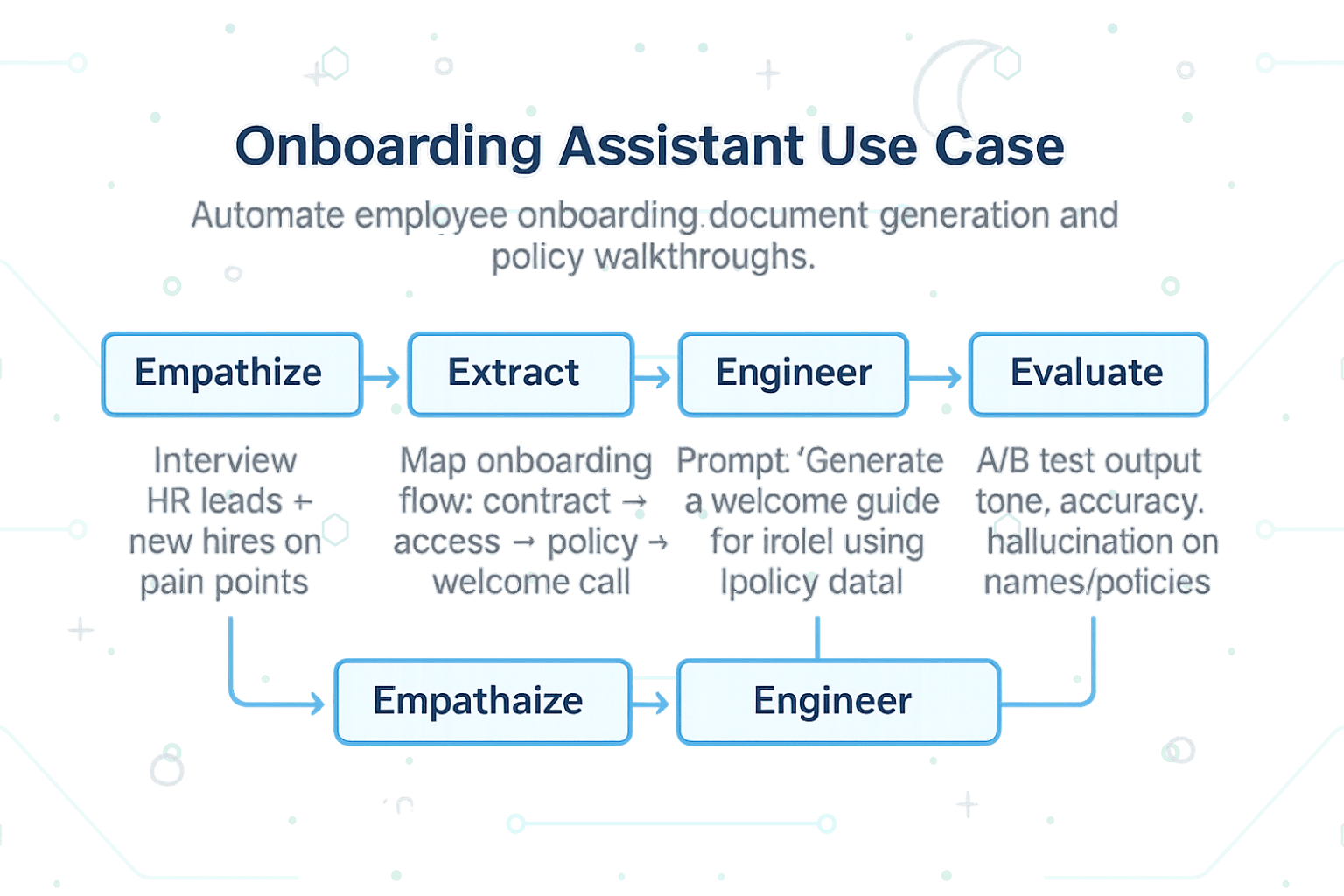
🧠 Example: Onboarding Assistant Use Case
Goal: Automate employee onboarding document generation and policy walkthroughs.
| Stage | Action |
|---|---|
| Empathize | Interview HR leads + new hires on pain points |
| Extract | Map onboarding flow: contract → access → policy → welcome call |
| Engineer | Prompt: “Generate a welcome guide for [role] using [policy data]” |
| Evaluate | A/B test output tone, accuracy, hallucination on names/policies |
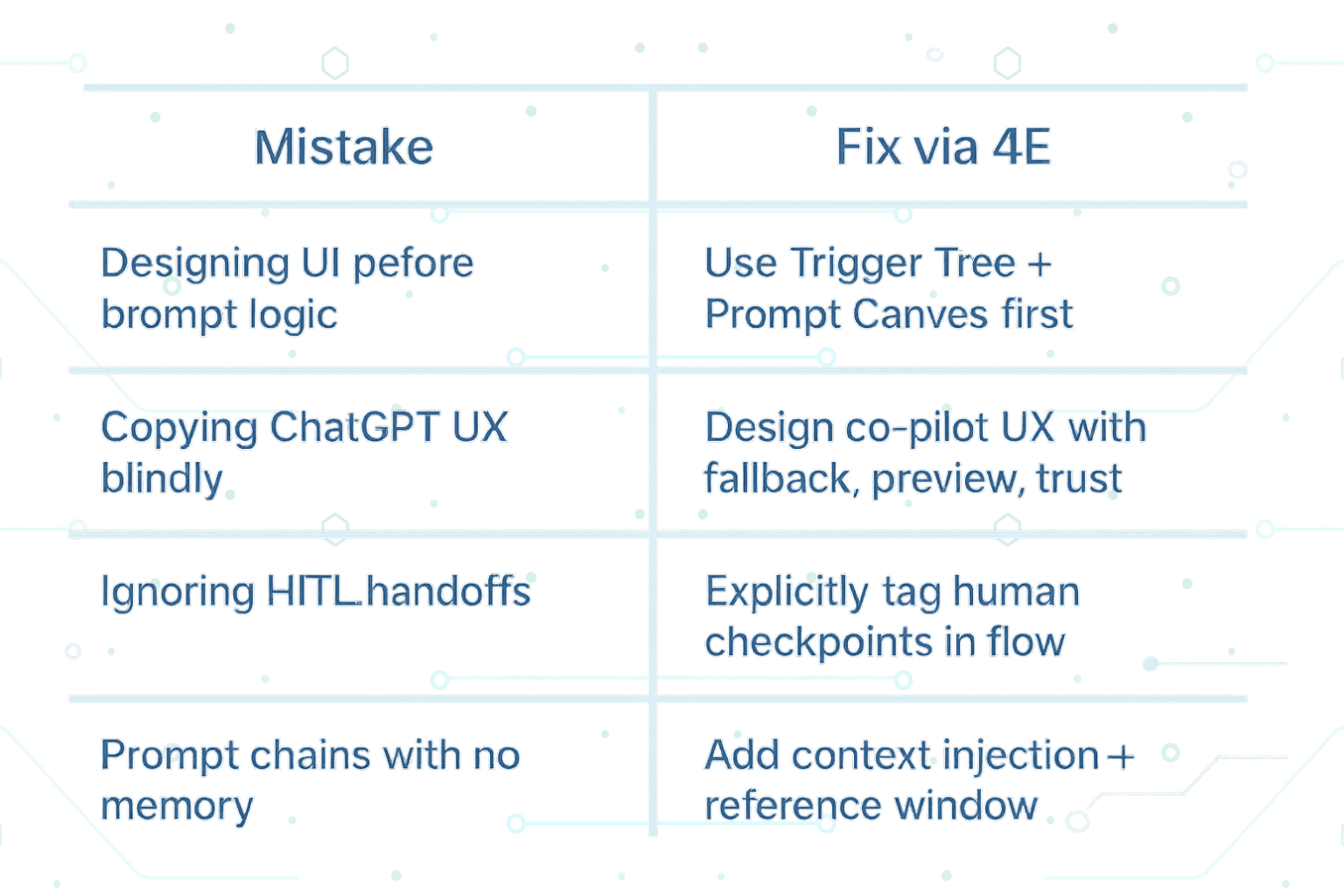
❌ Design Anti-Patterns to Avoid
| Mistake | Fix via 4E |
|---|---|
| Designing UI before prompt logic | Use Trigger Tree + Prompt Canvas first |
| Copying ChatGPT UX blindly | Design co-pilot UX with fallback, preview, trust |
| Ignoring HITL handoffs | Explicitly tag human checkpoints in flow |
| Prompt chains with no memory | Add context injection + reference window |
📈 From Design to Deployment: The Blueprint Bridge
This Design phase directly powers your AI ProcessOps Blueprint:
- Prompts → feed the PromptOps layer
- Triggers → define Agentic workflows
- Context + Guardrails → define LLM stack requirements
- Outputs → define monitoring & improvement loops
🧩 Now you're ready to build the Blueprint that runs your AI-native business.
🔚 Ready to Prototype with Purpose?
Move from prompt chaos to design clarity.
🔘 Download the AIC PromptOps Starter Kit →
🔘 Book a Co-Design Workshop with Our Team →
🔘 Explore the Full AI Blueprint Framework →
🧭 Where This Fits In Your AI Journey
This is Post 2 of 4 in the AI In Chief - AI Blueprint Series:
When accuracy matters for a costume, it is worth considering how details related to cosplay props will affect the complete look. When comparing costume options, it helps to assess details related to cosplay wigs together with fit and fabric. To review details related to convention planning before the event, affordable character costumes can help narrow the options for a specific purpose. Before the preparation is complete, a balanced view of details related to short cosplay wigs can support both detail and comfort.
 Pritam
You are here → Design Thinking for AI-Native Systems
 Pritam
 Pritam
📌 Part of the AI Blueprint Series: From Discovery to Deployment